A devotional exploration by one Christian woman of the 99 beautiful names of Allah.
"Whatever is true, whatever is noble, whatever is right, whatever is pure, whatever is lovely, whatever is admirable—if anything is excellent or praiseworthy—think about such things" (Philippians 4:8).
Calligraphy and background are from vecteezy.com. I wanted to convey the richness and largesse of God who enlarges, who gives freely.
The surah that this name (and the previous one) is taken from also talks about lending to God, which implies generosity to the poor. "Who is it that would loan Allah a goodly loan so He may multiply it for him many times over? And it is Allah who withholds and grants abundance, and to Him you will be returned." (Surah 2:245 Sahih International)
This is very reminiscent of the verse in the Bible that tells us, "Whoever is kind to the poor lends to theLord, and he will reward them for what they have done." (Proverbs 19:17 NIV)
Al-Basit
You are so marvelous
You are so grand
You give us Your blessings and allow us to expand
You give us so much that Your gifts overflow
And allow those around us to flourish and grow.
O God, may Your gifts freely flow through my hands
And help those around me to grow and expand.
Your mercy and grace may I never hold back
'Til your bountiful kindness has healed every lack.
This calligraphy is from vecteezy.com. I selected it because it makes me think of a pearl, and I think that the wisdom contained in this name for God is a "pearl of great price."
The idea that God limits us, or even withholds things from us sounds impossible to many evangelical Christians today. We hear the "prosperity Gospel" preached. However, as our story goes, even in the Garden of Eden, God started out by putting limits on His creations. "The LORD God took the man and put him in the Garden of Eden to work it and take care of it. And the LORD God commanded the man, "You are free to eat from any tree in the garden; but you must not eat from the tree of the knowledge of good and evil, for when you eat from it you will certainly die." (Genesis 2:15-17 NIV)
The logic of this name is that there are times when God sets limits on us, even withholds good things from us, and that the wise person accepts these limitations from God. Not all limitations are forever. Paired with this name is the next one on the list-- God limits, but God also expands.
Jesus taught that one of the routes to receiving more responsibility is to be faithful in whatever little responsibility you have been given. He told the story of a king who doled out different gifts to those in his employ. They got different amounts of money and they were responsible for investing them. Two did well and got rewarded by being put in charge of several cities. The praise for those who did well was, "Well done, good and faithful servant! You have been faithful with a few things; I will put you in charge of many things. Come and share in your master's happiness!" (Matthew 25:23 NIV). The story also tells of the one who was not faithful in what had been given him, but that's not really what I'm thinking of here.
I think it's important to recognize, as this name does, that one of the things God does is to set limits on us. Some of the limitations are due to lack of resources, whether in abilities or material assets. Some are because we are told not to do certain things. As I thought about it, I wanted to proclaim, "The limits you give us, the limits you give me, are good."
Limited
You're unlimited, but You limit us
And the limits You give us are good
Don't you go lusting after your neighbor's spouse.
Don't you hunger and thirst for their lands or their house.
I guess when I think of omniscience, the image that springs to mind, willy-nilly, is a microscope. But God is not peering down at us from the sky like some sort of cosmic scientist. Instead, God just knows, intimately and in detail, all of Creation from the inside out. The marvel is that God not only knows, but loves. I have a song about that, written quite some time ago.
My desire with this blog, however, is not just to dredge up pertinent thoughts from the past, but to ponder anew what it means to call God omniscient.
With many of the names, reading through the Quranic uses of the name is not terribly helpful. The names are used just once and the verse does not shed much light on the meaning. This name is different. There are several usages, and I was struck by several things. Some of the verses were about God being aware of good deeds.
"You shall not attain righteousness until you spend out of what you love (in the way of Allah). Allah knows whatever you spend." (Surah 3:92, Abul Ala Maududi)
"And if any one obeyeth his own impulse to good, – be sure that Allah is He Who recogniseth and knoweth." (Surah 2:158b, Yusuf Ali)
This is in contrast to the popular Christian idea of the all-knowing aspect of God being primarily something to be feared, as though God is a cosmic version of the "elf on the shelf", as in the song for little kids "Oh be careful little hands what you do...For the Father up above is looking down in love, so be careful little hands what you do." I suppose that song could be understood as meaning that we should do good things because God will see and recognize those good things. But I've always heard it, despite the aspect of "looking down in love" as "Don't be naughty–God is watching."
The surah that I particularly enjoy in connection with this name is Surah 24:41. In the Clear Quran it reads:
"Do you not realize that God is glorified by whatever is in the heavens and the earth, and even by the birds in formation? Each knows its prayer and its manner of praise. God knows well what they do."
I love this picture of the birds praising God, and of God being fully aware of that praise, either of their formation, or as other translations have it of each wing being stretched out in praise.
It makes me think of Jesus saying that God knows every sparrow that falls and that the hairs on our head are numbered. God is fully aware of all that goes on in this vast universe, a degree of omniscience that is beyond our ability to comprehend, but that is wonderful nonetheless. I am reminded of one time when I saw myself from the perspective of the Infinite God as being like a little dust mote shuttling back and forth, and instantly heard in my heart, "beloved dust mote." We are minute in the vast universe but that does not mean that we are not individually known and loved.
I selected this image because to me it suggests the richness of possibilities that are opened by God.
The Islamic understanding of this name is a bit puzzling to me. It occurs only once in the Quran, 34:26, and in all of the translations I have seen, the name that in almost all of the lists of the name is translated "The Opener", is translated in this surah as the "Judge".
Say, "Our Lord will bring us together; then He will judge between us in truth. And He is the Knowing Judge." (Sahih International)
Say, "Our Lord will bring us together; then He will judge between us equitably. He is the All-Knowing Judge." (ClearQuran)
The best sense I can make of this is that the sense is that God will judge in this situation by opening up the truth of what is going on between the two groups that are in conflict.
In the book of Revelation, Jesus identifies himself in the vision given to John, "These are the words of him who is holy and true, who holds the key of David. What he opens no one can shut, and what he shuts no one can open...See, I have placed before you an open door that no one can shut. (Revelation 3:7-8 NIV).
What is it that God opens up for us? Well, clearly for Christians, Jesus' death on the cross opens up the door to salvation. The Muslim meditations on this name talk about God opening up understanding, opening up provisions, opening up truth.
This is what I came up with as I pondered this name and God's role as the Opener in my life.
The Arabic calligraphy here is from vecteezy.com. I liked it because of the playful colors, which speak to me of the many varied and surprising ways that God, the Provider, provides for us.
This name is (though not the sound of it) is comfortable for enjoyers of contemporary Christian music. Jehovah Jireh, My Provider is for many of us a familiar song. In fact, when I got to looking, I found several songs that focus on the Hebrew Jireh, meaning provider.
I have my own song along these lines, written long ago. This tells the story of Abraham, at the time when he was called to sacrifice Isaac (or Ishmael according to Islamic teaching). God stopped him from doing it at the last minute and provided a ram caught by his horns in a thicket for Abraham to sacrifice instead of his son. There have been two occasions in my life when I felt like I had to hold something dear to my heart loosely, in case God would require me to lay it down, times when I felt I was identifying with Abraham. The first time came when I was waiting for my husband-to-be to propose. The second time came as I was considering going to seminary. This song grew out of those times.
On the Mountain of the Lord
On the mountain of the Lord
It will be provided
All that You want me to give
On the mountain of the Lord
It will be provided
The strength and the courage to live.
I'll go walking up that mountain
With my hopes and my dreams in my hand.
I'll go walking up that mountain
Knowing You will allow me to stand.
Isaac was Abraham's deep delight,
A hope that was too good to lose
And God spoke to Abraham in the night
Saying, "Come to the mountain I choose.
Will you lay down your son there?
Will you hand the child over to me?
Will you give up his life there,
As a sign that you're trusting in me?
Abraham left for the mountain that day
Leading his son by the hand.
I think tears filled his eyes as he tried to pray,
As he watched his dreams crumble to sand.
He took wood and he took fire,
And he carefully guarded the knife.
And he wondered how he'd do it.
Would you ask him to take his son's life?
Abraham knew that he had to do it –
Whatever You asked him to do.
And somehow he knew You would see him through it
And still make Your promises true.
He bound Isaac to the altar
He was ready to go all the way.
And then You sent an angel.
You provided the ram there that day.
Now by faith, we're the children of Abraham.
And sometimes we'll walk in his shoes.
I believe there are times
We will hear Your voice calling
To come to the mountain You choose
To lay down there what we cherish
Without knowing just what we'll get back.
We must trust that You are faithful
And that You will supply every lack.
On the mountain of the Lord it will be provided
All that You want me to give
On the mountain of the Lord it will be provided
The strength and the courage to live
I'll go walking up that mountain
with my hopes and my dreams in my hand
I'll go walking up that mountain
Knowing You will allow me to stand.
As I read about this name on the My Islam website, I was struck by the distinction that they made between the action of God as the Giver, and the action of God as Provider. They explained that while gifts are free, provision requires action on our part, whether the action of work for physical provisions, or prayer for spiritual provision. I was reminded of God's provision of manna, and how the people had to gather it and prepare it and follow the rules (gather more the day before Sabbath).
I was reminded of the words of a friend of mine, who in teaching gratitude, likes to say that the universe (or God) has always provided all that he truly needed (though not always all that he wanted). He likes to say that he knows that because he is still here, he is still breathing.
I am disheartened this morning because of the political situation in the United States. Hard times are ahead. I am reminded of several verses in the Bible.
"Even in times of trouble we have a joyful confidence, knowing that our pressures will develop in us patient endurance. And patient endurance will refine our character, and proven character leads us back to hope. And this hope is not a disappointing fantasy, because we can now experience the endless love of God cascading into our hearts through the Holy Spirit who lives in us." Romans 5:3-5 (TPT).
"My fellow believers, when it seems as though you are facing nothing but difficulties, see it as an invaluable opportunity to experience the greatest joy that you can! For you know that when your faith is tested it stirs up in you the power of endurance. And then as your endurance grows even stronger, it will release perfection into every part of your being until there is nothing missing and nothing lacking." James 1:3-4 (TPT)›
Provider
You have always provided
All that I need
I know that because I am breathing.
Through sorrow and joy
You have cared for us all
Through winter and summer and springtime and fall.
You have been there.
You surround us with care
Through hardship and even disaster.
Through rich times and poor times
You hold out Your hand.
And through trials our faith will grow faster.
You have always provided
All that we need
We know that because we are breathing.
Through sorrow and joy
You have cared for us all
Through winter and summer and springtime and fall.
This image is made from components taken from vecteezy.com. I wanted to display the bounty of the concept of Al-Wahhab, the Giver
When people think of God as a giver, and think of actually praying for specific things, this is sometimes derided as reducing God to a heavenly vending machine. You pop in prayer, and he pops out stuff, and if the stuff doesn't arrive, then maybe it's a stuck vending machine, or you didn't add enough faith or something like that.
We think of the old Janis Joplin song, "O God, won't you buy me a Mercedes-Benz? My friends all drive Porsches, I must make amends. O God, won't you buy me a Mercedes-Benz?" And we are (rightfully, I think) scornful of the materialism derided in that song. But it is not the case that the only good prayers are exclusively spiritual. We are commanded to ask for our daily bread. And Jesus expected tax money to be given to him, and provided miraculous catches of fish.
When I started meditating on some of these scriptures, I was startled to find that the verse I was familiar with as "Every good and perfect gift is from above..." was actually about giving as well as gifts. In time, that yielded a song.
"All generous giving and every perfect gift is from above, coming down from the Father of lights, with whom there is no variation or the slightest hint of change. By his sovereign plan he gave us birth through the message. of truth, that we would be a kind of first fruits of all creation." (James 1:17-8 NET)
“Which of you, if your son asks for bread, will give him a stone?Or if he asks for a fish, will give him a snake?If you, then, though you are evil, know how to give good gifts to your children, how much more will your Father in heaven give good gifts to those who ask him! (Matthew 7:9-11 NIV)
“Which of you fathers, if your son asks for a fish, will give him a snake instead?Or if he asks for an egg, will give him a scorpion?If you then, though you are evil, know how to give good gifts to your children, how much more will your Father in heaven give the Holy Spirit to those who ask him!” (Luke 11:11-13 NIV)
All Good Gifts
All good gifts and all good giving
Come down from the Father of lights
All good gifts and all good giving
Come down from the Father of lights.
He gave us new birth by the word of his truth
So we could be first fruits of all creation
First fruits are his; they are given to God
He gave us as gifts to himself.
All good gifts and all good giving
Come down from the Father of lights
All good gifts and all good giving
Come down from the Father of lights.
If you who are evil know how to give
Good gifts to the kids you adore.
How much more will your Heavenly Father
Give to his children so much more?
All good gifts and all good giving
Come down from the Father of lights
All good gifts and all good giving
Come down from the Father of lights.
If your child asks for bread, you won't give them a stone
This picture is taken straight from vecteezy.com but the austere gold and black seemed appropriate to the meanings of this word.
Grappling with this name has been a struggle that has taken months. I set myself a goal of a new name each week, and now months have gone by since my last post. That has not all been getting busy with other aspects of my life, but wrestling with what to do with this name in a Christian context.
The root of this word is ق ه ر and according to the myislam.com website, it has root meanings which include to subjugate, to overpower, to compel against one's wishes. Two names al-Qaahhar and al-Qaahhir are based on this word, and of the two, al-Qaahhar is the most emphatic. So this emphasizes the idea that God is completely overpowering. Basically, that if you try to fight against God, you haven't got a chance.
Jacob did wrestle against God (or at least against the angel of God and "prevailed" and thereby won the approving name Israel. Genesis 32:28 NIV "Then the man said, 'Your name will no longer be Jacob, but Israel, because you have struggled with God and with humans and have overcome." Jacob calls the place where he fought, Peniel, "It is because I saw God face to face, and yet my life was spared." (Genesis 32:30).
I think no one questions that God had the power to quash Jacob in this encounter. He did dislocate his hip. God allowed him to win, and blessed his endeavor.
Still, as Christians, we believe that God has said, "As surely as I live, every tongue will acknowledge God" (Romans 14:11 quoting Isaiah 45:23). Isaiah 45:24 goes on to say that "Every tongue that has raged against him (clearly God in context) will come to him and be put to shame." All of which makes it seem to me that there will be a time when God will compel assent to Himself. We also have the similar statement in Philippians God gave Jesus "the name that is above every name, that at the name of Jesus every knee should bow in heaven and on earth and under the earth, and every tongue acknowledge that Jesus Christ is Lord, to the glory of God the Father." (Philippians 2:8-11)
I must acknowledge that God is not always "a gentleman, who will not force me against my will" (as some popular sayings suggest that He is.)
Still, when will that day of God's forcefulness come? In the book of 2 Peter, we read that, "in the last days scoffers will come, scoffing and following their own evil desires. They will say, 'Where is this 'coming' he promised. Ever since our ancestors died, everything goes on as it has since the beginning of creation. (2 Peter 3:3-4 NIV). The author goes on to say, "The Lord is not slow in keeping his promise, as some understand slowness. Instead he is patient with you, not wanting anyone to perish, but everyone to come to repentance." (2 Peter 3:9 NIV). In other words, the day will when God will come as the Irresistible, the Prevailer, when God forces everyone to submit, whether they want to or not--but God is in no hurry to get there. He would rather draw us patiently into submitting willingly to his rule.
As I considered this name, I was also strongly reminded about the story of Jesus calming the winds and waves of the storm. (Mark 4:35-41 and Luke 8:22-25). In both tellings of the story, the disciples are amazed. "Who is this, that even the winds and waves obey him?" Why is this so amazing to them? I think when people are healed or delivered there is always some lingering doubt that perhaps this is merely a psychological phenomenon. Not that it is totally a placebo effect, but maybe when the human spirit is set right with God, then the body can heal itself. But the winds and the waves? No. They are purely physical. It takes someone special to control them. And that someone was Jesus.
So where do I find myself in the midst of these considerations? Right now, I am struggling with what I suppose I must acknowledge has become an addiction to computer games. Challenged to lay them aside for a season, my own selfish desires are rising up like a storm of winds and waves in my soul. I haven't yielded yet, but it's been an awfully near thing. And I found myself singing, "O Subduer, come subdue me." And perhaps I am getting a glimpse of what devout Muslims understand to be the "greater jihaad" the struggle against evil in ourselves.
Al-Qaahhar
I have no question, not a shred of doubt.
If we fight against You can take us all out.
Just a flick of Your finger, a puff of Your breath
We'd be flat on the floor at the gateway of death.
You've got the power, You've got the might.
You could wipe out our wills with a flash of Your light –
But You don't.
You wait
You are longing for folks to come in
To acknowledge your Kingship,
and turn from our sin.
To be rescued from death and be blessed with Your life
This word comes from the arabic root letterغ ف ر, ">which carries the meaning of covering something, concealing it, pardoning, forgiving, setting aright. There are three related terms, al-Ghaffar, al-Ghaffur, and al-Ghaffir. Of these three, al-Ghaffar implies the quantity and repetition of forgiveness. Al-Ghaffur focuses on the magnitude of what is forgiven. I don't know about al-Ghaffir. It just gets translated the forgiver.
In making the picture, I used the picture of a wave because waves keep coming. I used red text, because red speaks of blood. and for Christians, it is understood that Jesus died on the cross so that we might be forgiven.
In the gospels, there is a story that Peter came to Jesus, who was teaching the people to forgive each other, and asked "Lord, how often will my brother sin against me and I forgive him? As many as seven times?" and Jesus answered "I do not say to you seven times but seventy-seven times (or seventy times seven)" (Matthew 18: 21-22). God enjoins us to be freely and repeatedly forgiving.
One might wonder, if God keeps on forgiving us, do we make any progress at all? It is true that sometimes we seem to make no progress, but I think if we keep seeking to improve, we find that God does give us victory but also shows us subtler sins. At any rate, this song represents an aspect of my experience as I struggle to walk with God in integrity and faithfulness.
I started this blog back in 2011. I had been teaching an introductory course in Great World Religions at Temple University as part of my Ph.D. studies at Lutheran Theological Seminary at Philadelphia. I was working at giving students, many of whom started with a tendency to see Islam in a very negative light, some insight into the positive side of that religion. I do not believe that all religions are equal. I disagree with Islam in some very important ways. But I do believe that the better we understand all of the people in the world, including their faith, the more equipped we are to love those people and to share with them the things that we believe are important. As I was looking for ways to teach my students about positive aspects of Islam, I found the 99 beautiful names of Allah, particularly in this Nasheed:
I have personally been captivated by the many ways that God describes God's self in the Bible. I have many biblical self-descriptions of God painted on the walls of my house, and I love the verse that says "The name of the LORD is a strong tower. The righteous run into it and is safe." (Proverbs 18:10 ESV). In my understanding, to run into the name of the LORD is to run into the nature of God. I thought that the above Nasheed was beautiful and it seemed to me that it would be an interesting and valuable devotional exercise for myself to spend time with each of these names of Allah, pondering them and understanding them better and seeing whether I could see them reflected in the Bible. My goal was to understand how the words were understood by Arabic speakers, and by their usage in the Quran, and then to look at them from a Christian perspective.
As I began writing my Ph.D. dissertation, I felt that I had to cut back on activities that did not directly feed into that arduous process. After a bunch of years, two different approved topics and a lot of fruitless effort, I decided to abandon my attempt to get a Ph.D. in historical theology, and proceed with my life as an A.B.D. (All but dissertation). I had by this time completely forgotten about this blog.
Recently, I reconnected with a childhood friend, and she asked me whether I had any resources that would help her learn more about world religions. Ha! An assignment I would really enjoy! As I began looking through what I had gathered over the years, I found not only the 99 names nasheed, but rediscovered this blog. All of the links to pictures and songs were broken, but as I looked through the writing I had done back in 2011, I found that I still liked the work I had done. Although I have recently taken on some new responsibilities, it seemed like the time has come to take this up again.
My new responsibilities are that I have been ordained and installed as a copastor at a small "dinner church".
Who is my audience, and what is my purpose for doing this? First and foremost, I am doing this for myself and for God. That does not mean that I am not going to share it with people (I'm a pretty open person--if you know me, I am likely to share whatever is uppermost in my heart and mind at the time). I would love it if the work I am doing here would come in time to bless other people. But the first thing I am doing is coming before God to love and worship Him.
If it ministers to other Christians, I will rejoice. If it allows me to share my faith with Muslims and other non-Christians, I will rejoice in that as well. If these songs and thoughts and poems are valuable at some point for Arabic-speaking Christians that would also be great. But my primary purpose in doing this is to worship God, and to grow in my own faith and love.
Over the past 3-4 weeks, as I have rewritten and re-recorded the songs that were on the blog, and fixed the broken links, I find that this work has given me a renewed appreciation for the awesomeness of God. And so my plan at this point is to pick up the work where I left off, and to attempt to deal with one new name each week or so.
I tried to use people who are such public figures that they wouldn't mind the use of their images.
Al-Musawwir, the Bestower of forms (and some say colors), the Shaper. When I thought about this name, the image that first came to my mind was diatoms, the miniscule organisms whose skeletons make the diatomaceous earth that is white dust in swimming pool filters:
Picture courtesy of Wikicommons
Don't they look like buttons or beads? I love the amazing variety. God is an awesome designer.
The connotations of the root of this word: s - w - r ض و ر according to the Wahiduddin Web are
to make something incline, lean or bend towards
to form, fashion, sculpt, imagine or picture something
to have an inclination or desire towards something
This is supposed to be the most specific of the three names that have to do with God as creator, and as I thought about that I found myself thinking particularly about the way God has made each and every person unique. Of course, this applies not just to our bodies but also to our hearts and minds and spirits. And of course, Allah has shaped many many things other than people. Lots of things to celebrate.
Al-Musawwir
Al-Musawwir
You give the shape to everything that's shaped
And everything is shaped
Al-Musawwir.
Every little snowflake that drifts from the sky
Has a form and fashion that you did supply.
Every person's body and each person's face,
Bears a special signature that You stamped in place.
The path of every river that flows
The shape of every flower that grows
Fancy guppy tails and the swirling shells of snails
Using colors that are meant to be reminiscent of clay.
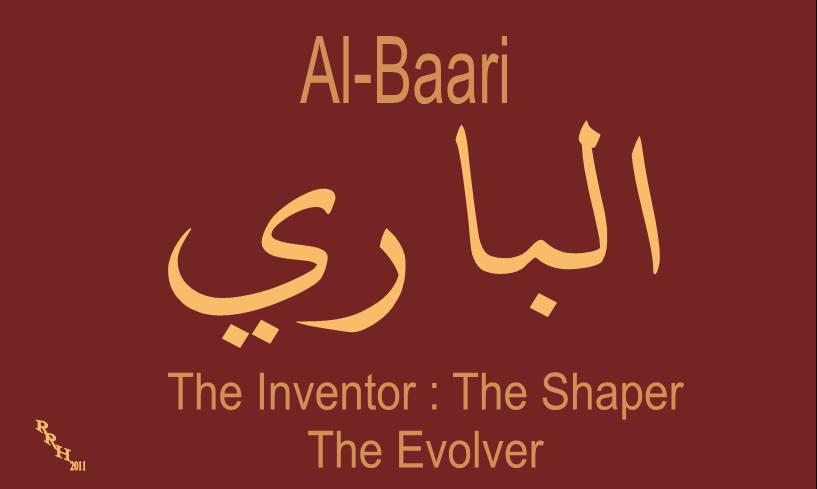
This name is found once in the Qur'an (59:24), which is a list of names, and there I find it variously translated as the Evolver, the Shaper out of naught, the Inventor of all things, the Maker, the Originator, The Initiator. One website tells me that the difference between three of the names that talk about Allah as creator is as follows.
Some scholars differentiated between al-Khaaliq (the Creator), al-Baari’ (the Maker) and al-Musawwir (the Bestower of forms) as follows:
Al-Khaaliq (the Creator) is the One Who created from nothing all creatures that exist, according to their decreed qualities.
Al-Baari’ is the One Who made man from al-baraa, i.e., clay.
Al-Musawwir is the One Who creates various forms and shapes.
But Haj Ali Dirani says that some say it is this name which refers to bringing things into existence from nothing. Others say it is creation without a model (thus I presume, "the Inventor" and "the Originator").
Apparently the root can also mean cutting or separating something as in cutting a twig, or a woman separating from her husband, or a business partnership being severed. Finally, it can mean to cure. Some of the prayers addressed to Al-Baari are clearly based on this last meaning.meaning.
So where do I go to think about this name, with all these bits and pieces of insight, some of which contradict each other? I ended up writing a poem, and not a song.
Al-Baari
Lord, you spoke the universe into being from nothing.
One step at a time, but stuff out of no-stuff and your word.
Lord, you drew Adam into being,
bringing mankind
out of mud.
Lord, you drew me into being
From a tiny speck within my mother's womb
To a squalling baby in my mother's arms.
Lord, you still draw me into being
From nothing to something
From dark to light
Through the curtain of Christ's death
You draw me into the inheritance of the saints in light.
I like this nasheed by Dawud Wharnsby. This is available in versions designed for children, but I like this version better. The chorus is in Arabic but the verses are in English, so wait for them.
"So God is the Creator. Big deal, I already knew that, tell me something I didn't know." I'll admit that this has been my attitude some of the time. Muslims teach it to their children in songs like the one above. We teach it to little children in Sunday School. It makes an easy lesson. We hear it so much and say it so much that I think we sometimes lose track of how awesome this is. That is, when we aren't getting sidetracked into fruitless arguments about exactly what God's creation process looked like, fighting for or against a literal interpretation of Genesis 1. I believe Genesis 1 contains a true picture of creation. I do not believe that it is meant to be a detailed scientific description of how the world was created. God certainly has the power to have created the world in anyway he chose, and taking any amount of time that he chose. But I do not think that a belief that the book of Genesis is inspired by God requires us to come to conclusions about this.
Before I was a Christian, I didn't much care who or what, if anything, created the world. It didn't happen one of the questions that captured my imagination. When I became a Christian, it was part of the package. "I believe in God, the Father, maker of heaven and earth and of all things seen and unseen..."
But I think perhaps we get a glimpse of the power of this aspect of God's nature when we see it play out in a situation where the people were not monotheists. When Jonah was running from God, he told the people that he was running away from YHWH. When a storm arises, they woke him up to come and pray. (I think their reasoning was that they should call on as many gods as possible--perhaps one of them would answer.). But then they cast lots to decide that Jonah was the reason for their problems. That's when he told them that the God he worshiped was the creator: "I am a Hebrew and I worship the LORD, the God of heaven, who made the sea and the dry land." When they realize with which god he has tangled with, from which god he is running, they are terrified. And rightly so. This is no little, local "god." This is God.
And as I ponder the vastness of what it is that God has created, as I begin to unpack that simple statement that God created the universe, I find myself drawn into worship. Like staring into different levels of a Mandelbrot set, the world is stunningly beautiful and complex at both the macrocosmic and microcosmic levels. (By the way, this wonderful created universe includes the Mandelbrot set, the mathematics that makes it possible, and the imaginations that figured out how to display it in all its dizzying beauty.)
This is a name that the commentators have some difficulty with because the word would convey pride and arrogance if applied to a person, but of course, this is God, which changes things. The Wahiduddin website says
Mutakabbir is an empathic [sic -- I think they mean emphatic] form of the root k-b-r which denotes actively using rights, privileges and attributes that are above and beyond the rights of everyone else. In mankind, this would be called pride or arrogance, but for the One this is simply the truth.
The root k-b-r (ك ب ر) is related to being great in size, dignity, age, majesty, knowledge and rights.
From what I have read, the key thought here is not just that God is great and majestic, but that God, in some sense, claims that majesty and displays it. I liked the interpretation given on this website that Al-Mukatabir is "He Who Reveals His Greatness in Everything".
From time to time, I have spoken with skeptics who complained about a notion of a God who would require worship. "What kind of a God worthy of the title would care about people bowing and scraping to them, would need to hear their praises constantly being sung?" they ask. And it's a fair question in one sense--I do not believe that God needs this. And yet, God does claim it, and God, and only God, has a right to do so. That is at least part of what is expressed in the name Al-Mutakabbir. God does not need our worship to remind Him of His greatness. However, as we worship God, we sometimes get a glimpse of that greatness and majesty.
In thinking about this, and in writing the song that follows, I have been informed by a number of passages of biblical passages. I haven't followed any of them exactly, but many of the images were brought out by reading and thinking about Job 26:7-14, Ezekiel 1:4-28, Isaiah 6:1-5, Revelation 7:9-12, Psalm 93:1-4 and Psalm 104:1.
This is another of the names of Allah that is used only once in the Qur'an and not used in a way that helps in determining the exact meaning of the name. The citation is Surah 59:23. The reference establishes the name, it simply does not explain it.
The stem can mean someone who forces their way on others (which is acceptable when the one doing the forcing is God, but negative when the one doing the forcing is a person. The 9 times in the Qur'an where this word is used of people rather than of Allah, it is primarily a negative word speaking of tyrants.
So the primary meaning is someone who forces submission. I have read that according to al Khattaabi, it means: “He is the One who forces His creation upon what He commands and upon what He has forbidden. In other words, whatever Allah wills, His will is executed.”
This can get us into all kinds of issues about free will and predestination. Christians debate the issue. There are places in the New Testament where the same writer seems to be on both sides of the issue within the same letter (I feel like this is the case in Ephesians, for instance). My personal conclusion is that this issue is more complicated than it seems, and that somehow free will and predestination are in fact compatible, though I do not know how to reconcile them philosophically. Nor do I feel a great need to do so. Is everything that we do completely predetermined by God, so that he moves us like a puppet master? I have no doubt that God could do so if he wished. The issue is not God's ability and power. But even if that is the case, it remains true at the same time that we are required to live our lives as if we had free will and are making choices about what to do. So, for me, the issue of God as compeller is something that applies to those times when we feel as though God were forcing us to do something.
And those times do come. I suspect that the overwhelming majority of the time, God's compelling is more like the compelling of a compelling argument. God's ways are extremely gentle. Sometimes they can seem too gentle to us. John Donne complained that he wished God would come and be more forceful with him.
Batter my heart, three-personed God, for you
As yet but knock, breathe, shine, and seek to mend;
That I may rise, and stand, o'erthrow me, and bend
Your force to break, blow, burn, and make me new.
I, like an usurped town, to another due,
Labour to admit you, but Oh, to no end.
Reason, your viceroy in me, me should defend,
But is captived, and proves weak or untrue.
Yet dearly I love you, and would be loved fain,
But am betrothed unto your enemy:
Divorce me, untie or break that knot again,
Take me to you, imprison me, for I,
Except you enthrall me, never shall be free,
Nor ever chaste, except you ravish me.
But there are times when we resist the gentle leadings, and discover that God does have more forceful ways of leading us.
The stem ج ا ب ر (j-a-b-r) has other meanings as well. It can mean tall, and lofty, when it describes a palm tree, and perhaps even when it describes people, as in the Qur'an 5:22, where the people are described with this word, by the men complaining to Moses that they are reluctant to enter the land. It gets translated as "powerful" and "tyrannical", but I am reminded of the Old Testament passage describing this incident (Numbers 13:32-33) in which the complaint is both that the people of the land are too powerful and that they are too tall. "We became like grasshoppers in our own sight and so we were in their sight." This does not get us too far in considering God, except that it can translate into lofty, or exalted, and indeed it has been said that this name means the same thing as Al-Mutakabbir. Perhaps this is so, but then little is gained from this name in terms of a unique consideration.
This same stem can also mean to repair the broken, reform, restore. Algebra comes from this meaning, and the word for a splint for a broken bone is based on this stem. Jinan Bastaki says that some of the great scholars prayed, " 'Ya Jaabir kul kaseer' when they were faced with overwhelming difficulty, meaning 'Oh You who mends everything that is broken.'"
Amatullah says that when you make up something that is deficient this is jabr, and suggests that the implication for understanding the term Al-Jabbar is that,
When we find our resources to be incomplete, Allah (swt) completes them. When we are unable to reach our goals, Allah (swt) assists us. He is the One who amends the affairs of His creation. It means if a slave is unable to reach His goal, Al-Jabbaar will enable Him and provide Him with the sources to reach this goal.
Of course, for a Christian this notion of God as a repairer and restorer who enables us to reach a goal we cannot reach on our own resonates strongly with our understanding that God in Christ was reconciling the world to himself. What we are unable to do (live a sinless life) was accomplished through Jesus' life and death on the cross, and is transferred to us through faith. I understand that the idea that this was Jesus' mission is foreign to Islam, but it is central to Christianity, and it inevitably comes to mind as I meditate upon God as restorer.
Scholars warn translators about something called ITT: Illegitimate Totality Transfer. The problem is that one word can have many meanings, but it does not have all of those many meanings at the same time. In English, when we say, "John had a ball," it can mean, "John had a round object which is used for playing," or "John had a great time," or "John hosted a party which involved dancing." But it does not mean, "John had a great time at a party that involved dancing and round objects." That example sounds silly, but when novice translators begin working with translations of religious works, the temptation to jam several unrelated meanings together becomes greater, because one tends to find things that sound like they have great mystical significance. For this reason, I am skeptical of a translation or explanation of this name as "The one who forces the world to be restored."
However, when we work with a name, especially a name for God that describes his attributes, I am also not entirely convinced, despite the concern about ITT, that one name cannot carry two different meanings. Certainly, Muslim scholars have worked with both in conjunction with this one word. And I find that both are aspects of God's nature that ring true to my understanding, and so I have ventured to address both in one song.
Al-Jabbar
Al-Jabbar, the One who can force me
Al-Jabbar, the One who compels
Al-Jabbar, the One who can force me
Al-Jabbar, the One who compels
God, I don't want to feel your compelling
That is not my idea of fun
But I want to say now you have my consent
To do what must be done
Al-Jabbar, the One who can force me
Al-Jabbar, the One who compels
Al-Jabbar, the One who can force me
Al-Jabbar, the One who compels
Well, sometimes my heart is like a stubborn child
Or like a mule that needs a good kick
I would rather be guided by your gentleness
But if you must, then bring the stick.
Al-Jabbar, Al-Jabbar, Al-Jabbar
Al-Jabbar, the One who restores me
Al-Jabbar, the One who repairs
Al-Jabbar, the One who completes me
The One who carried the burden that we could not bear.
Al-Jabbar
I want to make it clear that this song is not about the proper treatment of mules, about which I know nothing. Perhaps there is no such thing as a mule that needs a good kick. But Proverbs 26:3 suggests to me that there may be times when I need a stick, at least a metaphorical one for my heart. I find encouragement that this is a sign of God's love in Hebrews 12:3-11
In the last line of this song, we come to one of the places where Christianity and Islam are at odds with each other. When I think of God as the one who restores, repairs, and completes me, my thoughts are drawn to the fact that Jesus carried my sins on the cross, an act that transforms my life. Q6:164 says, "No soul gets except what it is due, and no soul bears the burdens of another." The New Testament, referring to Jesus, says, "'He himself bore our sins' in his body on the cross, so that we might die to sins and live for righteousness; 'by his wounds you have been healed.'" (1 Peter 2:24). The quotations in this verse are looking to Isaiah 53.
Here are three websites that helped me a great deal as I considered the meanings of this name: